Do Something Great • October 04, 2009
"Full Circle"
More Features
Browse Features
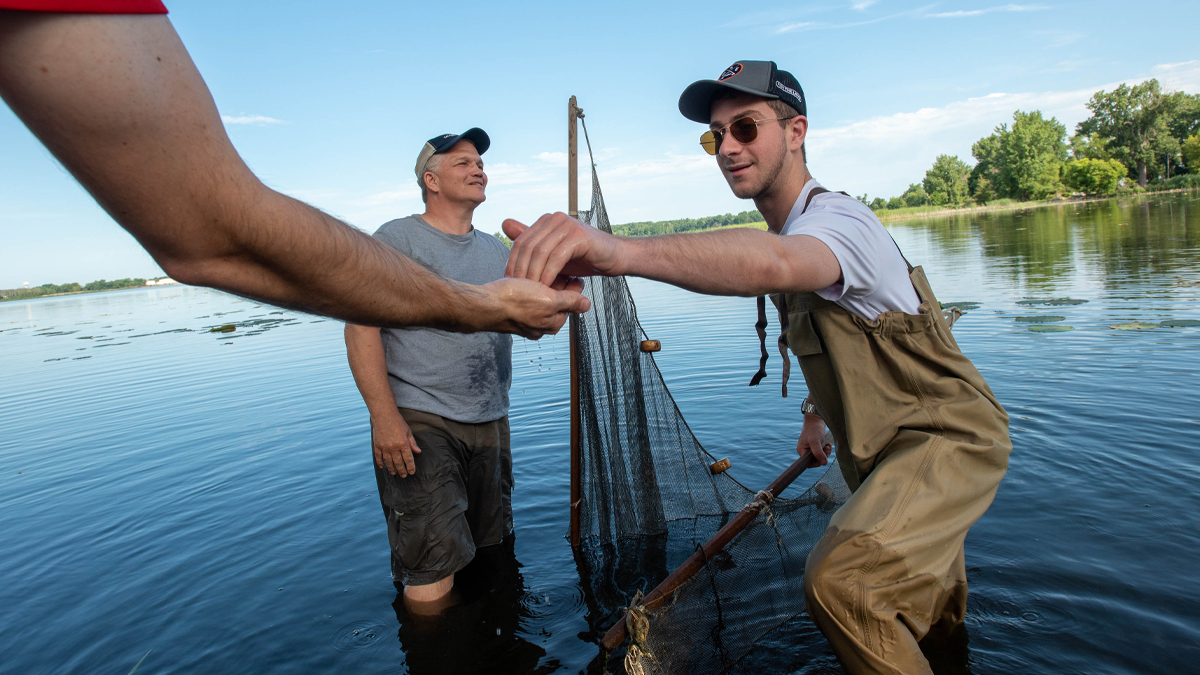
In Cameroon, undergraduate Kristen Ritchey studied pastoral herders alongside Professor Mark Moritz. Ritchey received financial support from Ohio State for her work.
Video Player Controls
Screen reader users:
Tab into the tool bar.
Then turn the virtual cursor/buffer off to enable pass-through mode.
For JAWS: Insert + Z.
For NVDA: Caps Lock + Space Bar.
For Window-Eyes: Ctrl + Shift + A.
Right and left arrow keys navigate tool bar controls.
Keyboard shortcuts are also available while in pass-through mode:
Alt Control P for play and pause.
Alt Control S for stop.
Alt control M for mute.
Alt control R doubles size of player.
Alt control T toggles focus between elapsed time and toolbar.
VoiceOver users: Use the Enable Player VoiceOver Access button to make the toolbar button text display and then use the Focus Toolbar button to jump into the toolbar. (VoiceOver with Safari 3, only. Safari 4 beta does not work with toolbar. Disable VoiceOver and use keyboard shortcuts.)
As an undergraduate at the University of Leiden in the Netherlands, Mark Moritz took a trip to Cameroon to study pastoral cattle herders.
"I just got hooked on doing research, being in Cameroon," he says.
Now an anthropology professor at Ohio State, Moritz has built longstanding relationships with collaborators in Cameroon. His research focuses on how herders in northern Cameroon coordinate their movements to avoid conflict and overgrazing, despite a lack of a formal land use plan.
"They have no conflicts over access to use the land," he says. "This suggests that there's some kind of management system, but there is no apparent management system. So there are no rules to regulate access. Anybody can come. Access is open and free for all. But nevertheless, there are no conflicts."
Moritz's work crosses disciplines on campus; he works with researchers in veterinary medicine, biology, and geography. He is a fellow at Ohio State's Mershon Center for International Studies, an interdisciplinary think tank on campus.
"One of the great benefits about being at Ohio State is that it's a big university," he says. "It makes it easier for me to find collaborators who are interested in similar topics."
He also involves students in his research.
"It's fun to work with students," Moritz says. "I feel like I'm coming full circle."
Undergraduate Kristen Ritchey recently spent three months in Cameroon under Moritz's direction.
“Doing research abroad is probably the best thing I could do as an undergrad. ”
—Kristen Ritchey, who received university grants to research abroad
Ritchey, an anthropology major, is studying labor relations between absent land owners and hired cattle herders. Researching in Cameroon also allowed her to experience the local culture: She slept in a tent on the floodplain, learned to cook in the bush, and even received an African name.
She studied abroad thanks to financial aid from the Office of Undergraduate Research and the College of Social and Behavioral Sciences.
Ohio State offers many opportunities for students to get financial aid not only for tuition, but also for "extras" such as research projects like Ritchey's. Last school year, 82 percent of students received money. And the university was one of the first in the nation to respond to the economic crisis with scholarships through the Students First, Students Now initiative.
"Doing research abroad has been probably the best thing I could have done as an undergrad," she says.
Moritz's work in Cameroon was funded partially by the National Science Foundation through its Faculty Early Career Development (CAREER) award. The prestigious award recognizes young researchers' dual commitment to scholarship and education.
His research has implications for the sustainable management of natural resources not only in Cameroon, but in the rest of the world and even Ohio.
"The pastoral management that I study is a situation of open access," he says. "There are many situations of open access."
Take Lake Erie, where fisheries compete among one another. Or in terms of pollution, the lack of stringent regulation of carbon dioxide emissions into the air.
"We can actually have sustainable management of these resources not with a top-down approach but with rules that are shared by agents, by the different user groups."