
Lighter, stronger, tougher
Alan Luo’s discoveries are building more efficient, sustainable vehicles
Breakthrough by breakthrough, Alan Luo is shaving pounds off cars and trucks. Airplanes. Even smartphones are more efficient due to his research.
From Luo’s labs across Ohio State’s campus, he produces the strongest, lightest metal alloys the world has ever seen. And he’s guiding new generations of students along the way, engineers who will spread his wizardry far and wide.
“I want to deliver value to society,” says Luo. “I want my life to be dynamic. My research is curiosity driven. But curiosity must be relevant to doing something that changes the world.”
Ohio State named Luo a 2026 Distinguished University Professor, the university’s highest faculty honor. A professor in the department of Materials Science and Engineering and the Department of Integrated Systems Engineering, Luo is the Donald D. Glower Chair in Engineering, leads the Lightweight Materials and Manufacturing Research Laboratory and is the Director of the Advanced Casting Research Center (ACRC) at Ohio State.
Since joining Ohio State in 2013, Luo has reshaped how new alloys — metals created from aluminum, magnesium and titanium — are conceived and engineered. And through his numerous collaborations, his discoveries are directly shared with the manufacturers who put them into production.
Real-world applications are at the heart of Luo’s work. He began his career at General Motors, where he became a GM Technical Fellow before arriving at Ohio State, and he’s never forgotten how critical basic research is to the manufacturing industry.
“My research covers three areas: Developing the computational tools to cut down on trial-and-error time, creating new lightweight alloys and composites and developing new manufacturing processes.
“Scientific research shouldn’t stay in a library. To impact society, you need to meet the demands of manufacturing. That’s what drives my work. We believe we can drive innovations faster and more efficiently. It's a win-win situation for everyone.
“But we need to build that bridge. With my industry experience I feel like I'm uniquely positioned to do that because the real-world experience always taught me how to design material that's meeting the real-world requirements.”
A key piece in the bridge from research to manufacturing is the ACRC, which Luo brought here and directs. The ACRC is North America’s largest industry-university consortium in metal processing and manufacturing and features global partnerships across the manufacturing sector.
“I don’t do this by myself, we have a team, a network through the ACRC. We come together to identify challenges and address them.
“We always challenge the limit of manufacturing technologies, there’s always room for improvement and that’s so exciting. It’s never boring. We are free to explore new things and challenge the limits of materials to make them lighter, stronger, last longer.”
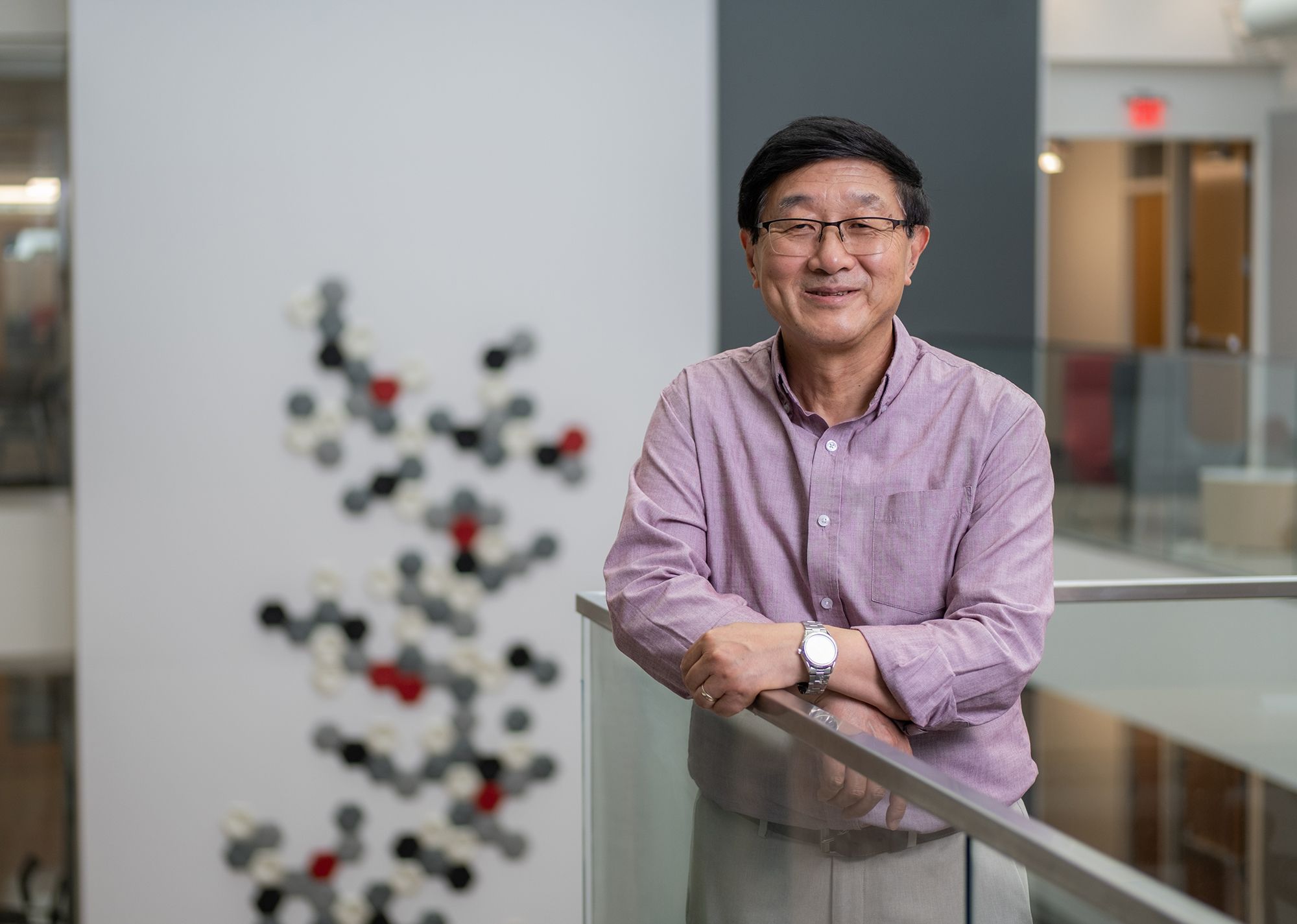
Sustainability is at the heart of Luo’s work. And one of those out-of-the box ideas Luo has been working with industry partners on is using scrap metal to produce his light, strong materials.
“My current focus is on critical materials. And sustainability. We are recycling end-of-life scrap to extract the critical materials we need from the so-called waste to make them useful. In that way, we are going to not only reduce our dependence on the imported materials and the primary resources from the Earth that are not renewable, but we also reduce cost and improve the performance of the products that eventually we're going to have.
“It’s energy efficient. It’s resource conscious. It’s sustainable for the whole industry.”
Luo benefits industry in another major way, through the students he produces. From PhDs to undergrads, students work hands-on in his labs on his projects but also their own. And every aspect of the student experience is tailored to fit an individual’s path.
“Mentorship is exhilarating. Students come in fresh and you have the opportunity to nurture them so they can pursue their own interests. I mentor each student differently. Some want to work for industry, others want to work in national labs, some want to become professors. I give each different challenges so they get the training they want and many have succeeded in those exact career paths.
“As a university professor, you become a lifetime mentor. I stay in contact with many of my students, give them advice, help them change careers or get promoted. It’s very satisfying to influence a student life.
“I find teaching engineering is a little different than teaching a science discipline because we not only need to teach them the fundamentals but also how the world works. It’s not just about passing an exam. Scientists are trying to understand the world. Engineers are trying to change the world. I want my students to understand how the world works and then figure out how to make it work better.”
And to Luo, Ohio State is the perfect place to change the world.
“Ohio State is in the heartland of U.S. manufacturing. This is the state with significant investment in automotive, aerospace, semiconductor, many sectors of material science, so this is exciting.
“But also, the students are top-notch. They love hands-on work and they love to be challenged. The whole culture here, it drives innovation, that makes the world better.
“We tackle the biggest challenges. No idea is too crazy because at the university, we’re supposed to be crazy. Every day, every week, every time I come to the lab, we’re trying something new. We’re pushing boundaries. Every day is exciting.”