
Internships, discoveries and more
Here's what happens when an institution increases its investment in research and innovation
Until about a year ago, neither Bennett Kolda nor Austin Porter knew much about the next-generation batteries that power electric vehicles, drones and tools.
That changed last May when they were selected for the inaugural cohort of interns in the BATTERI program (Bridging Academic Training Through Experiential Research and Innovation).
The intensive 10-week program brought together seven students from Ohio State, Columbus State Community College and Wilberforce University. Participants learned from and worked alongside industry and academic experts in facilities such as the world-class Battery Cell R&D Center, gaining skills and insight into advanced battery manufacturing.
“Never in a million years did I see myself doing this,” said Kolda, a senior who switched his major from finance and economics to mechanical engineering. “It’s crazy to be immersed in this, working in a world-class facility, surrounded by awesome researchers. To be here on the front lines of these emerging technologies is mind-blowing. And to think we have a hand in something bigger than ourselves, it’s been an incredible experience.”
During the internship, students collaborated with Ohio State researchers and industry experts from companies including Honda and Schaeffler and even conducted market research for an Ohio State startup.
After the program concluded, Porter and Kolda continued working in the battery center as undergraduate research assistants as the 22,000-square-foot facility prepares to open this spring.
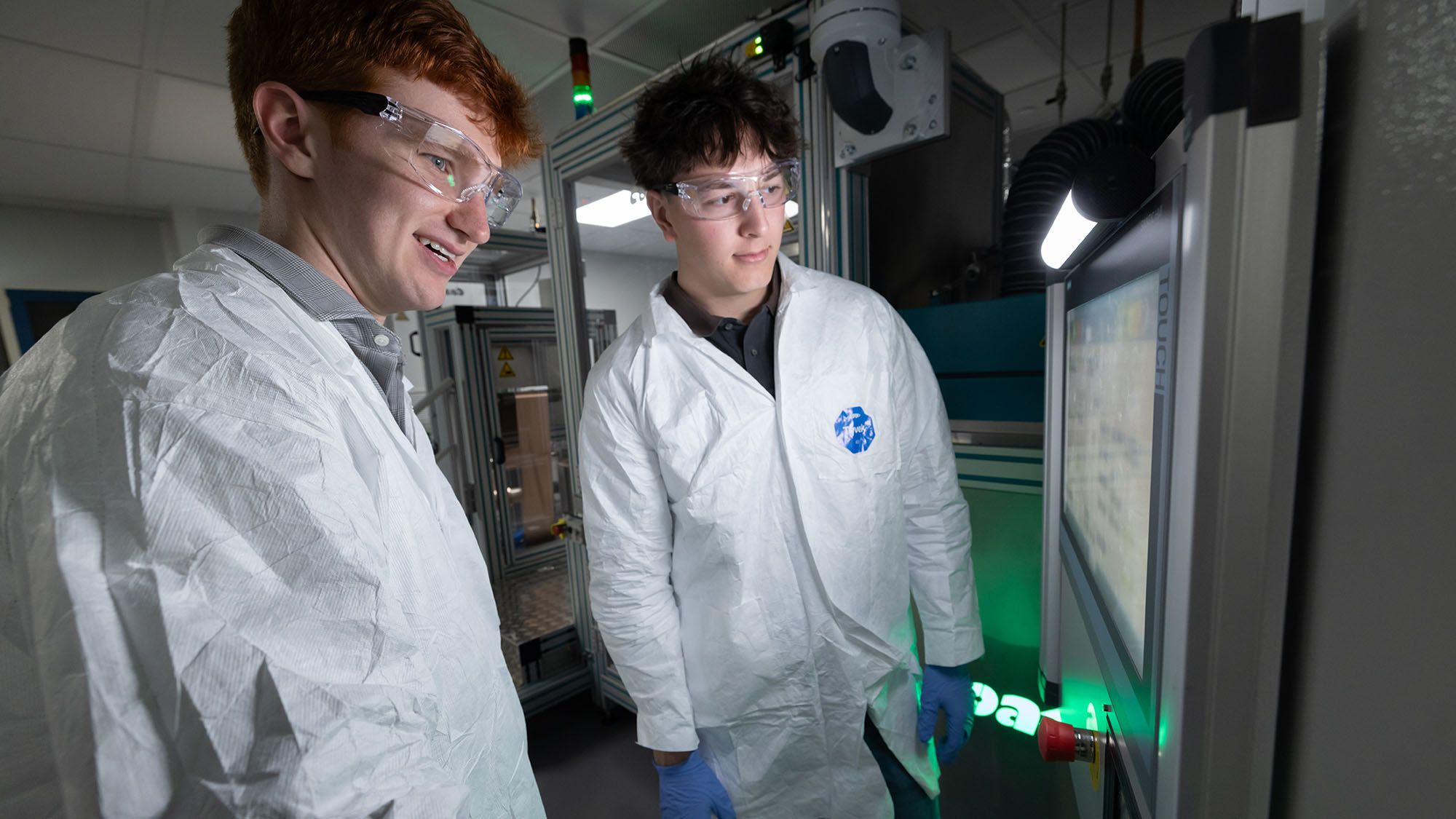
“The point of the program is to get students in here and working, and from the moment you arrive, things really snowball,” said Porter, a fourth-year electrical and computer engineering major who later secured a summer internship with Schaeffler. “It’s been a big learning experience. My favorite part is collaborating with other students and experts in the field. It’s very exciting.”
BATTERI is funded by the National Science Foundation. Jay Sayre, BATTERI lead principal investigator, director of innovation for the Institute for Materials and Manufacturing Research — which operates the battery center — and research associate professor in materials science and engineering, said the program will “serve as a catalyst that will shape advanced manufacturing by lighting pathways for the next generation of the STEM workforce.”
Kolda said the work taking place in the new Battery Cell R&D Center reflects Ohio State’s commitment to cutting-edge research that will shape the future.
It also highlights the power of sustained research investment. Recently, the university announced that research expenditures grew 6% in fiscal year 2025, reaching a record $1.68 billion in research and development spending.
Those investments translate directly into opportunities such as the BATTERI internship and the battery center — along with initiatives like the following:
Innovation in language learning
At the core of Matthew Steinhauer’s work is a simple idea: language isn’t just studied, it’s lived. As a PhD student in Japanese pedagogy at Ohio State, Steinhauer created Vosmosis, a virtual reality platform that lets students “step into” the language. Instead of memorizing grammar rules from textbooks, learners immerse themselves in virtual Japanese offices and classrooms to practice social cues and gestures, the rhythms that make communication feel real.
“I want a future where students are not told, ‘This language is too hard for you,’” Steinhauer said. “Instead, we can say, ‘We have another way.’”
The power of Vosmosis is access. It levels the playing field by providing a study-abroad-like experience without the prohibitive costs or travel requirements.
Steinhauer’s work exemplifies how academic ideas transform into real-world innovation. By supporting students who turn research into startups, Ohio State is building an innovation economy that prepares a globally fluent workforce.
A breakthrough vaccine to protect newborn piglets
Ohio State professor Quihong Wang has developed a new vaccine technology that gives farmers a more effective way to prevent porcine epidemic diarrhea virus (PEDv), a highly contagious coronavirus that can kill more than half of infected newborn piglets.
PEDv outbreaks can reduce pig production by up to 12 percent, placing major economic strain on farms and costing producers as much as a month of income. Current methods to fight the virus are often unreliable and can increase the risk of other diseases.
“This virus is very, very deadly for neonatal pigs,” Wang said. “Within one week after they are born, they can be infected and die. There is no time to immunize the piglets themselves.”
Wang’s safer, more effective vaccine is now being commercialized through Innovative Viral Solutions, offering a path toward improved animal health, stronger food production systems, and meaningful economic impact for farming communities.