Driving reactions
Claudia Turro harnesses light to transform cancer treatment and clean energy.
Claudia Turro was eager to start the 2026-27 school year for good reason: she was back in her laboratory full-time.
After serving as Ohio State’s department chair of chemistry and biochemistry since 2019, Turro stepped aside and stepped back into the lab to return to her research hands-on, making new discoveries alongside her students.
“It’s not work for me, it’s fun,” Turro says. “I come to work every day to solve puzzles, it’s about doing science.”
This year, Turro was named an Ohio State Distinguished University Professor, the university’s highest honor. Her game-changing work delves into inorganic photochemistry, examining how light interacts with metal-containing molecules allowing for major applications in cancer treatment and clean-energy production.
It’s fundamental research that helps develop light-activated drugs that can target tumors, and molecular systems that use sunlight to produce hydrogen fuel.
“I never think about legacy, I think about what else I can do,” she says. “I’m excited to get back to the research lab and go in new directions. I still have a lot to contribute.”
Question:For most people, chemistry is such a difficult subject. How did you fall in love with it?
I meet people all the time who say, ‘I don’t like chemistry.’ But it’s probably because they had a bad teacher. Anyone who likes to discover anything should be excited by chemistry.
When I was young, I liked all of science and math, also art. What got me interested in chemistry was, when I was young, I realized that everything around us is made up of atoms. And these are all the same atoms in the periodic table. They make up everything around us.
And the difference was the way that they're connected to each other. That was fascinating, that you could change the properties of a material, just from this one periodic table, and you could get everything. Science excites me. You have an observation and you ask why? How can I make it better to do X, Y or Z? Generating new knowledge, new molecules that do something different, that’s really my passion.
Question:Explain your research:
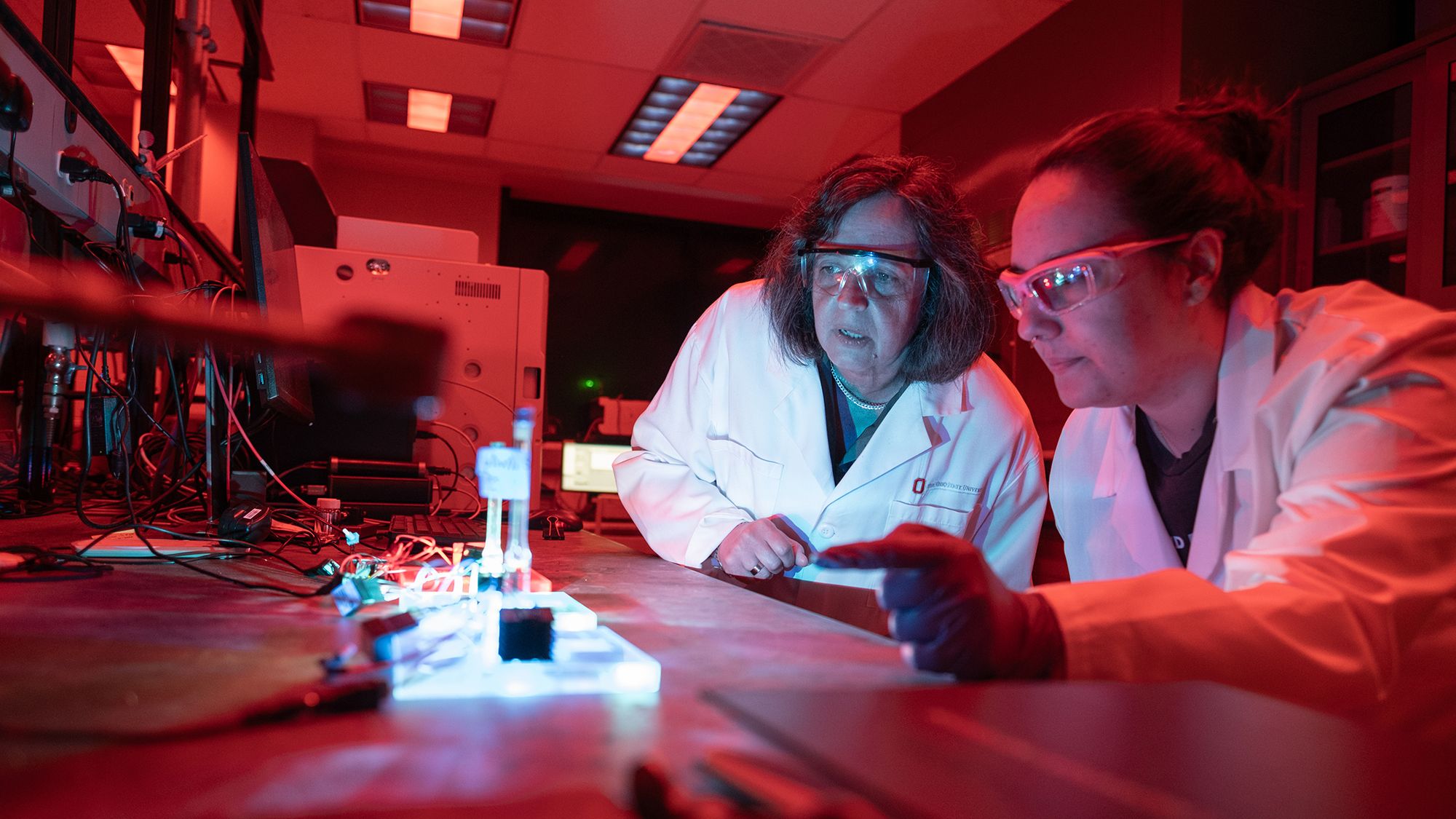
The research in my group focuses on using light to start reactions. How do we make a molecule different so that we can control what it does? We design the molecule and then we use lasers to see what happens when they absorb a photon of light.
When a molecule absorbs a photon of light, it then has more energy. It can do reactions it couldn't before. Now it can be used for a number of applications. The two problems I’m most interested in are phototherapies for cancer treatments and solar energy conversion for renewable energy. I believe these are important problems.
Question:These are difficult problems and I'm sure you put in a ton of hours. Where does your persistence come from?
I'm originally from Argentina, and my parents moved to Brazil when I was 10. I had to learn a new language and go to school in a new language for four years, and then my stepfather was transferred to the U.S., to Miami, so I had to move to Miami, go to high school in Miami, and again learn a new language. I think that teaches you to keep going, to adapt. That whatever happens, I can make it work.
But even more than that, I’ve always wanted to do something that would be useful for the world. I want to have a purpose. And students feel the same way. They're not going to join your research group unless they feel there's some ultimate goal that will benefit society.
Question:How important is the student experience in your lab? How do you see your role as an educator?
My role is training students, teaching them not just the research that they're doing, but teaching them how to think on their own. How to develop and solve their own problems. And then how to move on in the world, not just to be in academia; we need good people in industry, national labs, the whole sector.
Question:What's it like seeing a student succeed?
That's why we're here, to see students succeed. It is a great feeling that you helped train that student and that they're now on their own and are able to be successful in their career. When students come to work in my lab I want them to learn they can be independent, they can forge their own futures, that they have all the resources available to make that happen and are capable to do so.
Question:Your nominators for the Distinguished University Professor honor pointed out how important your example and your work has been toward improving the number of women and underrepresented students in chemistry and science. Can you talk about that?
When I first started, there were a lot fewer women in PhD programs in chemistry in general and that has changed. When I first started at Ohio State, I was the third woman faculty member in the chemistry department, I believe. Now at least a third of our 50-some faculty are women, so it’s changed quite a bit.
I’m Hispanic so I’m very welcoming to everybody in my lab. I want to make sure everyone is treated with respect. That’s an important environment for science in general.
But also, when I was vice chair of our department, I started a mentoring program that helped increase the number of minority and women graduate students. Then when I became department chair, I started a mentoring program for undergraduates and it has been very successful also.
Seeing how successful those mentoring programs have been feels great. I hope that success continues, not only for underrepresented and female students but because in any area, you need all viewpoints. You need diverse points of view. It’s important to have global viewpoints and voices.