
Building the future, one atom at a time
Kevin Singh is building the quantum devices that will reshape our world
Ohio State physicist Kevin Singh is building one of the largest neutral-atom quantum computers in the world. Right now. From his lab on campus.
He’s also leading an Ohio project to lay the groundwork for a future quantum internet. It’s technology that could reshape computing, cybersecurity and the future of science.
Sounds like heavy stuff. Until you talk to Singh about it. He speaks about the work as someone who’s never lost his excitement or sense of wonder.
“I’ve always been fascinated with quantum mechanics. What we produce is beautiful and it’s fun,” said Singh, assistant professor of physics. “I often have these moments when I’m just amazed by it all.
“Once you are doing this kind of research, it’s hard to leave because you feel you have purpose. You know you are satisfying your internal human desire to understand what’s around you. Building these devices, it puts you into the fabric of existence. What motivates me is trying to learn more about the nature of reality.”
As an experimentalist, Singh builds large-scale programmable quantum devices that promise to unlock a new era of computing, tackling certain problems unimaginably faster than conventional machines. Think of impenetrable cybersecurity, life-saving medical breakthroughs or stock-market predictions in moments.
Quantum computers do this by harnessing the behavior of matter and energy at the smallest scales to dwarf the capabilities of the most powerful conventional computers. However, today's quantum computers remain limited, error-prone and as large and unwieldy as the original computers of the 1940s.
“You walk into my lab and everything around you is the quantum computer,” Singh laughs. “It's a full room of optics, lasers, electronics and vacuum chambers orchestrated together by a very large classical computer to be the fully functioning quantum apparatus.”
As expected, companies like IBM and Google are making huge investments to advance the technology rapidly. But academic campuses, it turns out, are doing some of the best work in the nation. And Ohio State, with its Center for Quantum Science and Engineering, is emerging as a powerhouse for quantum research, anchoring the state and the Midwest as a potential national hub.
Singh is key to that rise, especially his pioneering work in areas such as neutral atom arrays — using a single laser beam to hold a single atom and move it around to build the computer.
“The world’s best quantum computers are the way my group builds them,” says Singh, who arrived at Ohio State in early 2025. “(Our current) computer is maybe the fifth or sixth largest in the world right now, it just needs other bells and whistles to be fully functioning, but our aim is to be one of the world’s largest.”
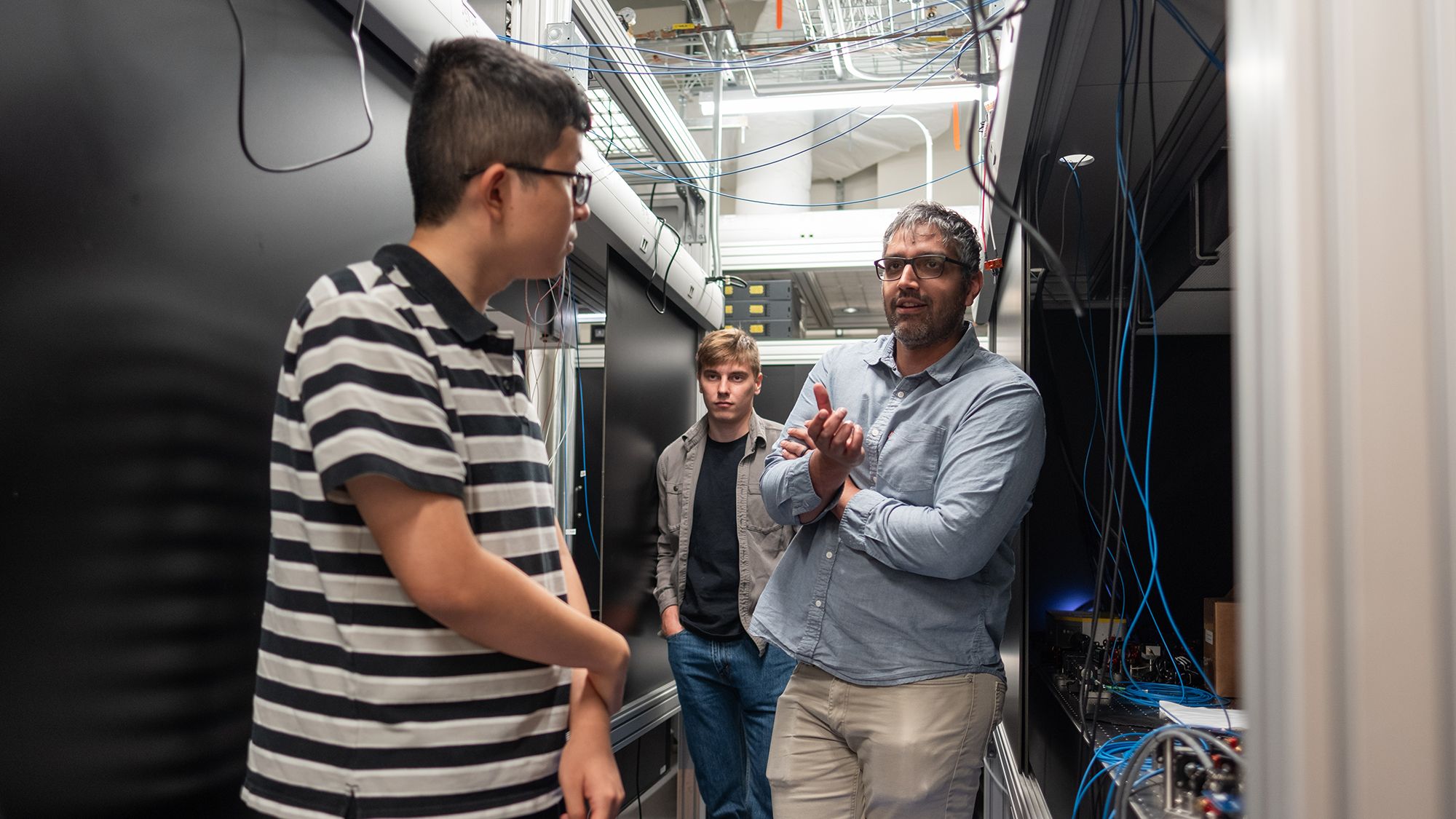
Singh was recruited to Ohio State because of his groundbreaking research. He came here because the university offered generous financial support for the laboratory and because of the large pool of students available to recruit for his interdisciplinary lab, built on a team work ethic.
“There’s a lot to know to build these,” Singh says. “There’s a lot of coding, engineering, lasers, optics, vacuum chambers, plumbing… it’s all aspects of engineering, electronics and physics. We can teach you all that. But the most important skill I look for is teamwork. Otherwise, it all falls apart.”
Since he began building his lab, he’s gone from two Ph.D. students to another seven undergrads. Singh says that the university plans to add more quantum computing researchers and an interdisciplinary Ph.D. quantum program, of which there are only a handful in the country.
“Ohio State is really doing a fantastic job of predicting the direction society is going,” Singh says. “Ohio is one of the top states for getting new businesses and corporations. And where technology is going, electronics are only going to get smaller, so everyone will need to know quantum mechanics to build future technologies. So the obvious choice is to invest in quantum.”
To illustrate this, Singh became principal investigator on a project late last year to lay the groundwork for a future statewide quantum internet that could scale up quantum computing by connecting the technology across the country. This project is in partnership with NASA John Glenn Research Center, the Air Force Research Laboratory, and researchers at SRICO, Inc and Denison University – all in Ohio.
“We need to be able to build something everyone can tap into,” Singh says. “This is the building block for that future quantum Internet, and we’re building it in the state of Ohio.”