
From the classroom to the cosmos
Meet the undergraduate students behind the Nancy Grace Roman Telescope
For a select group of Ohio State students, their learning has gone beyond the classroom and into the universe.
NASA’s Nancy Grace Roman Telescope will capture images of the universe, helping scientists study far-away galaxies, investigate how the universe is continuously expanding, and maybe even discover new planets.
When it launched in August, these Ohio State students and their faculty mentors had a front-row seat to history – and their own work going to the farthest reaches of space.
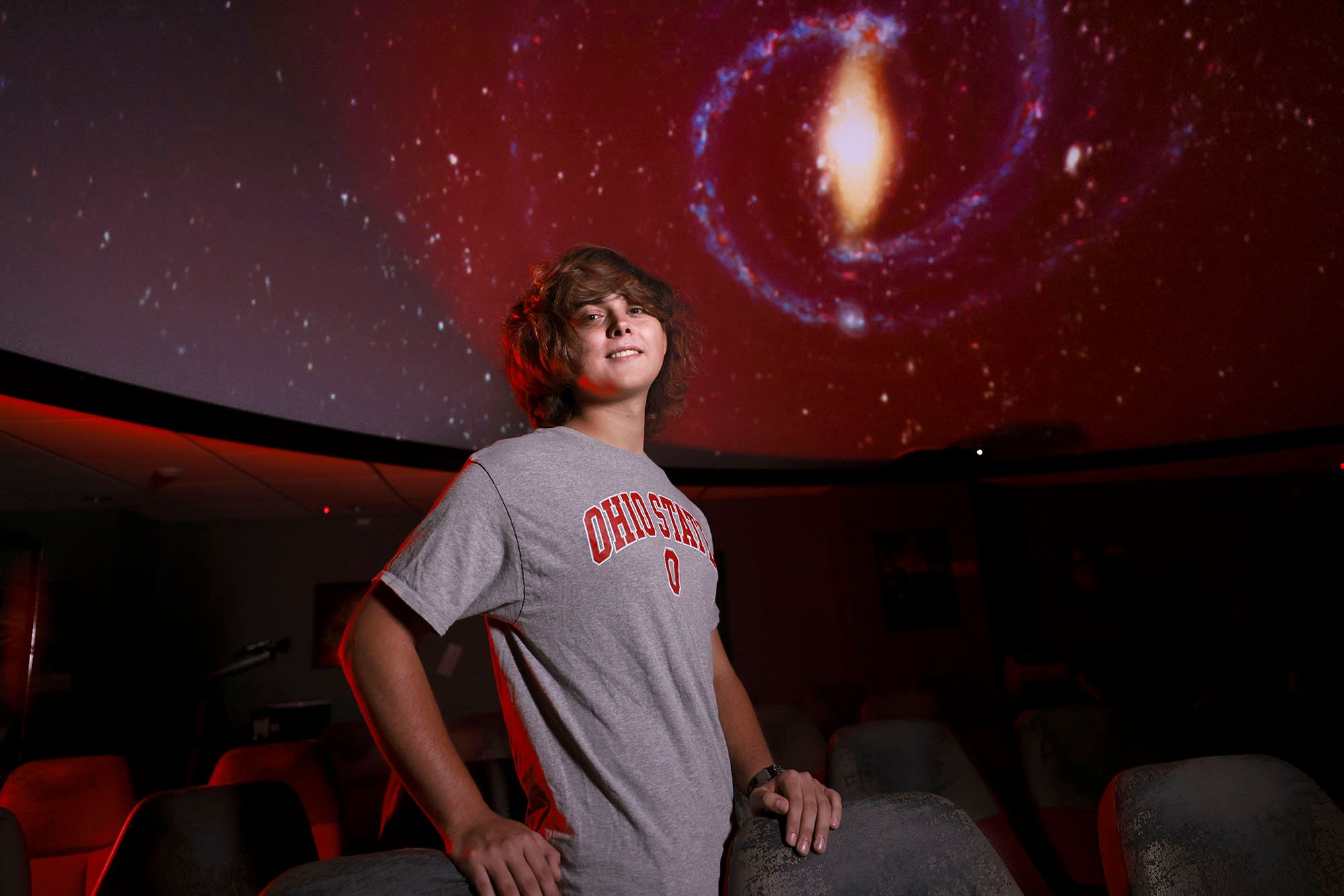
“Seeing the Roman launch was truly breathtaking. We got to witness something we had worked on for years take shape in a magnificent way, and that feeling will stick with me for a long time,” said Zac Brutko, a fourth-year studying cosmology.
“My work with Roman has provided me with opportunities that are incredibly hard to find as an undergraduate researcher – I have gotten to travel to science meetings, work on novel issues in physics, and be an active participant in one of the largest science collaborations in the field.”
Classroom knowledge leads to real discoveries
The Roman Space Telescope was built to answer questions that go beyond any classroom. Are there any other planets like Earth around other stars? What is causing the expansion of the universe to speed up?
Ohio State students directly contributed to the investigation of these questions and the Roman project.
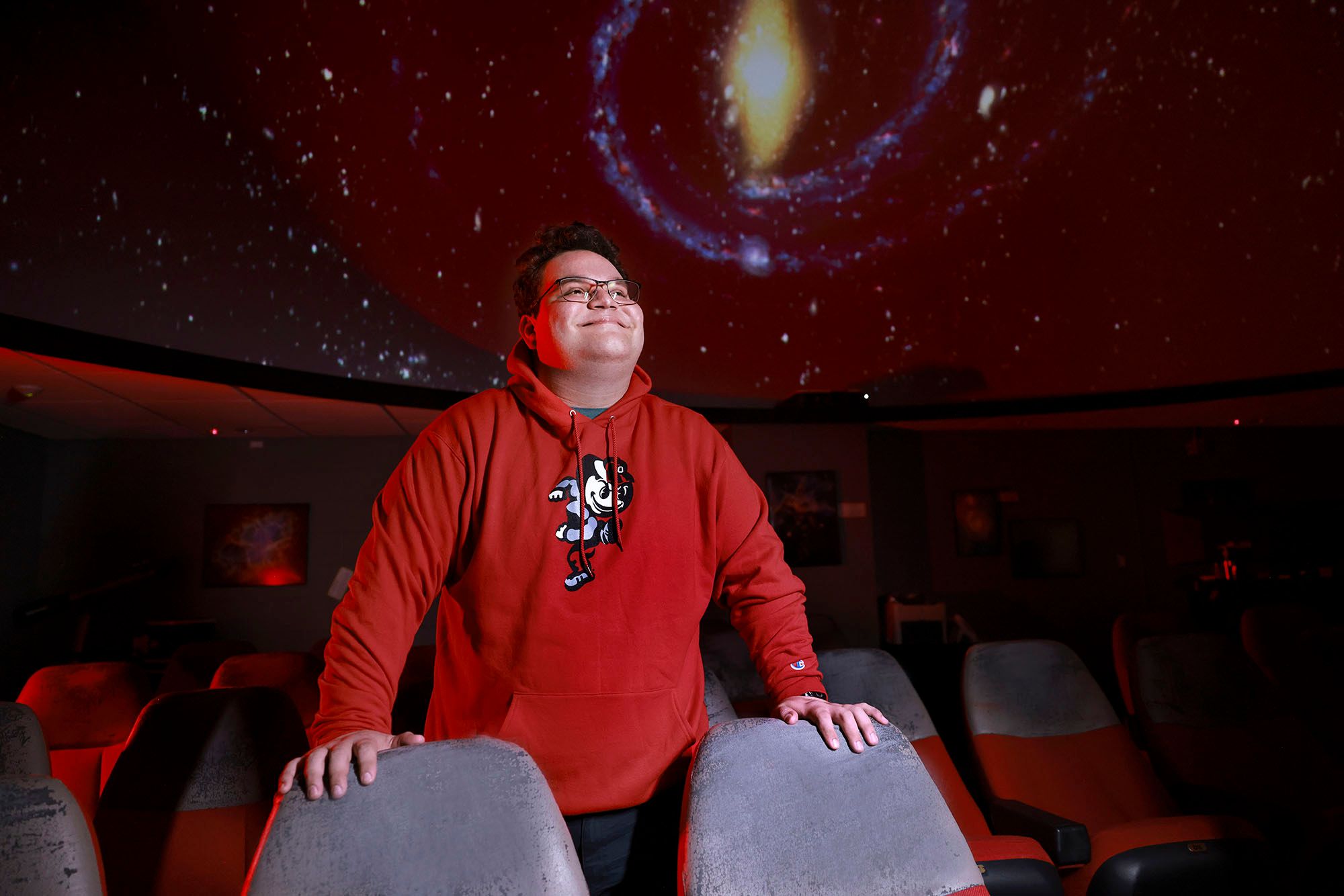
Amy Albert, a fourth-year studying cosmology, developed software that would help the telescope detectors produce accurate data.
“Watching the telescope launch filled me with awe, and the idea that my code will touch data from almost a million miles away from earth is incredible,” she said.
Sai Vidyud Senthil Nathan ’26 worked on the Roman project as an undergrad at Ohio State, developing a computer simulation that would estimate what types of planets Roman might be able to detect.
“I did not know anything before I started this research project. So, they kind of taught and built us up from there. In the classroom, they teach us all the background things, all the theory,” said Senthil Nathan, who graduated with a double major in aerospace engineering and astronomy and astrophysics. “They lay a solid foundation where they can build us up with projects and research. The quality of undergraduate education is incredible.”
 “A lot of this experience I will push forward into my future career.”Sai Vidyud Senthil NathanOhio State graduate
Brutko studied how high-energy particles that travel through space could impact the telescope’s images. “These cosmic rays are often very high in energy and, if not modeled correctly, can have an adverse impact on the data Roman collects,” he explained.
Ollie Snow analyzed how the telescope’s images could be affected by heat produced by the telescope itself.
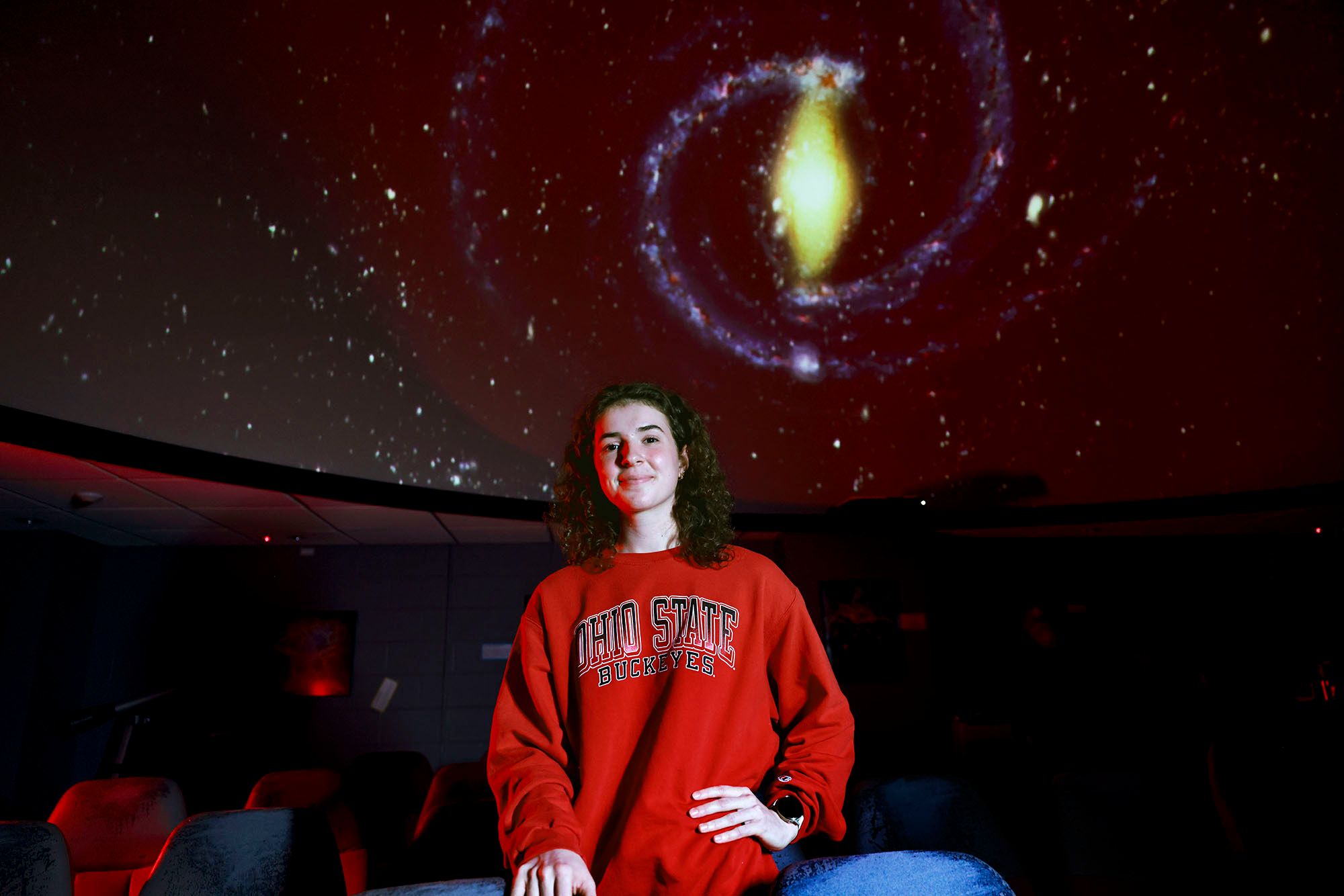
“I analyzed and modeled how each pixel responds to thermal emission,” said the second-year student studying cosmology. “These models are now integrated into the image processing pipeline, so that the thermal emission from the telescope is subtracted out of the processed images.
Kara DiLudivico, a fifth-year studying cosmology, participated in calibrating the telescope’s detectors. This helped develop researchers’ understanding of how the telescope interprets light so that its observations can be accurately interpreted.
“I was not expecting to be a part of a NASA project coming into Ohio State,” DiLudivico said. She had dreamed of working on a NASA telescope or project since she was 12 years old and said the experience “will have a special place with me for the rest of my life.”
Mentorship helps students grow
Contributing to a NASA project can be intimidating. The Roman project allowed the students to learn from faculty mentors, who helped the students navigate challenges in the project and build confidence in themselves.
Throughout the project, Albert found that having mentors available to answer her questions and support her through her work in the project made a difference. Dr. Christopher Hirata, who played a leading role in the Roman’s technical and scientific design, serves as her research advisor.
“(He) has been the most helpful,” she explained. “His excitement about the project is infectious, and his kindness and openness built the community in our research group.”
DiLudovico credits Hirata, other researchers, and her fellow students with helping her build her confidence.
“They've made me realize that I can do anything,” she said. “These are the best mentors that I've ever had, and they influence me and teach me how I can be a good mentor to others in the future.”
Sitting at Cape Canaveral this summer, Senthil Nathan could think back to mentors he had at Ohio State who helped him find his way there.
Dr. Richard Pogge, the head of the Imaging Sciences Laboratory, stirred a research interest in Nathan during his first year. He went on to work on instrumentation engineering with Dr. Jonathan Crass. Eventually, Nathan was mentored by Dr. Scott Gaudi, a principal investigator in the Roman project.
“Whenever I was stuck on some piece of code or something technical … we always used to work through things together on his blackboard,” Senthil Nathan said. “He also guided me through his research and advised my honors research distinction thesis. ... I graduated with honors research distinction because of his mentorship.”
Building skills beyond research experience
The students have developed skills that go far beyond. Through working on this large-scale project, they have learned communication, teamwork and problem-solving skills.
“I have gotten much better at asking questions,” Albert said. “This was a whole different kind of challenge. I couldn’t have been nearly as successful if it weren’t for regular meetings with grad students where they help the undergrads understand the project better.”
Students also had the opportunity to take part in new and unique experiences.
For example, Senthil Nathan learned how to advocate for funding in Washington, D.C., during 2025. He spoke with Ohio congressional leaders to push back against NASA cuts at the time.
“A lot of this experience I will push forward into my future career,” he said.
Likewise, Brutko described opportunities to attend science meetings, work on new physics problems, and become an active participant in a large research team.
“Working on Roman has truly been a dream come true,” he said. “I think it can be very easy to lose sight of what you are studying as an undergrad. Seeing Roman launch reminded me why I started studying astrophysics in the first place: I get to study the greatest mysteries in the universe using some of the most advanced technology ever. It’s amazing!”