The value of basic science research
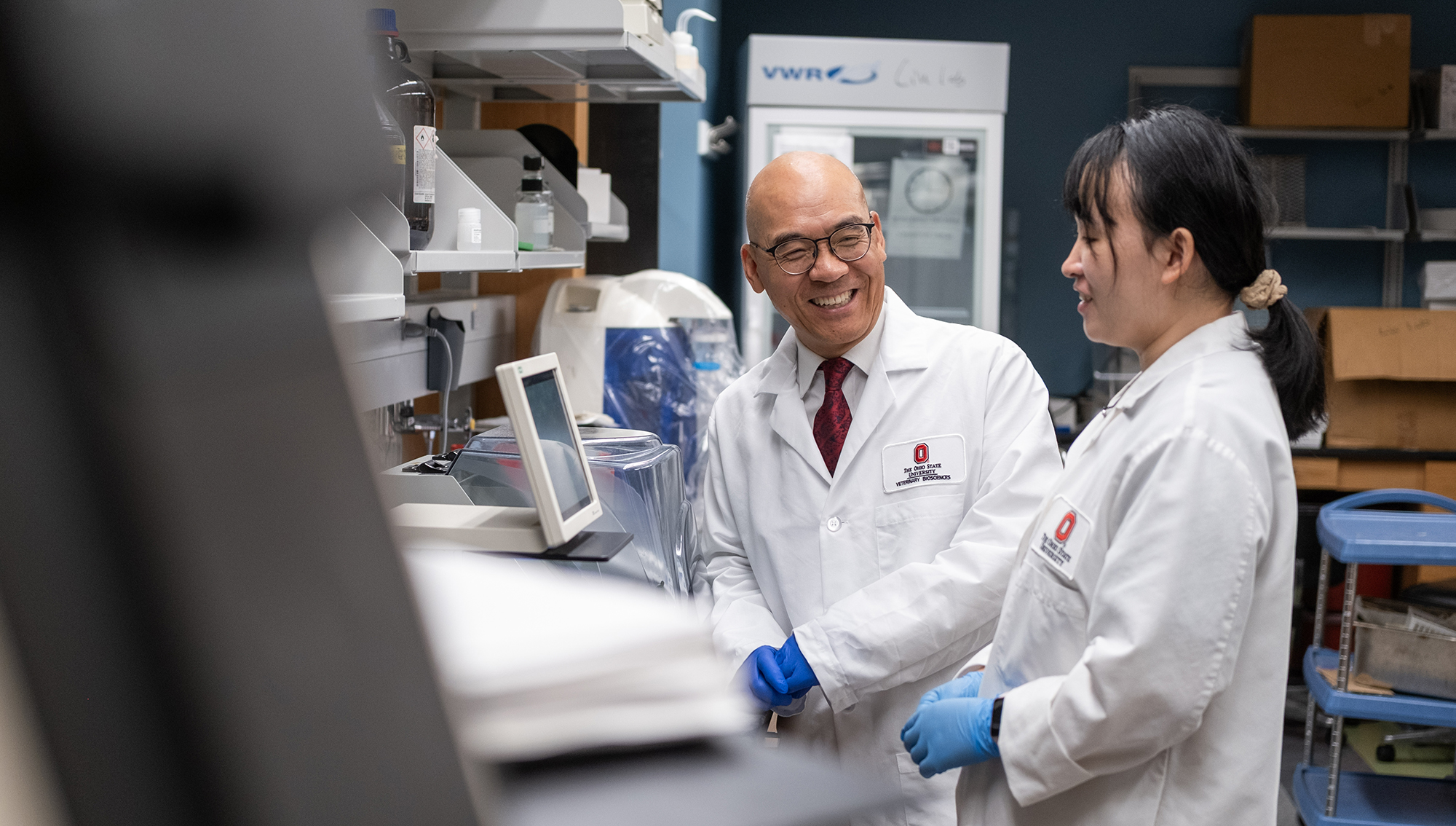
Virologist Shan-Lu Liu champions the fundamental explorations that lead to life-saving discoveries.
For nearly three decades, virologist Shan-Lu Liu has studied one of biology’s most fundamental questions: What happens when a virus attacks a cell?
His research explores how viruses enter cells, how they interact with their hosts and how the body responds. It’s work that helps us combat infectious diseases ranging from HIV and Ebola to Zika, SARS-CoV-2 and even influenza.
Liu was honored this year as a Distinguished University Professor, Ohio State’s highest faculty honor. As a professor in the Department of Veterinary Biosciences and Department of Microbial Infection and Immunity, his work has transformed our understanding of virus-host interactions and immune system responses, findings that have been critical to vaccine formulations.
Liu is driven to save lives and promote health by discovering how biology works, training the next generation of scientists, fostering interdisciplinary collaborations and building the knowledge needed to combat outbreaks.
In this Q&A, Liu discusses viruses, scientific discovery, pandemic preparedness, mentorship and why basic science matters.
Question:In the simplest terms, what do you study?
I’m a virologist. We study how viruses infect cells and how viruses impact the biology of the infected cell. We study the interaction between the virus and the host and the purpose is to understand how we can develop the therapeutics for antivirals and vaccines.
A virus is the smallest microorganism and they don’t have the machinery to make more of itself, so it has to rely on the host cell for its replication. That can damage the cell and make us sick. So they are nasty. But they can also be modified for human gene therapies and put to good use. So studying viruses is fascinating because you learn not only about a virus but about host biology.
Question:HIV is a powerful example of how science can change people's lives. What does its history tell us?
It emphasizes the importance of basic science. In 1981, the first case of AIDS was discovered and we had no idea what it was and it became a death sentence. But through 40-plus years of research, it is no longer the death sentence it once was. It can be treated as a chronic disease.
That transformation came from decades of basic scientific discoveries that eventually led to therapies. This is why I really hope we continue to support basic science. You may not know exactly where a discovery will lead, but major advances often begin with basic research.
Question:Can you explain the One Health approach to research and why it is so important to your work?
One Health refers to studying the collective field of animals, humans, environments, etc. A virus can infect certain types of cells, but they don't recognize boundaries, so they can move between species.
For example, there are a lot of viruses in animals, we call it the reservoir. In particular, bats. As the only mammals capable of sustained flight, bats have unique physiological and immune adaptations, including elevated body temperatures during flight and distinctive antiviral responses. These adaptations allow bats to tolerate infection by certain viruses with relatively little disease, enabling viruses to be maintained in bat populations. Under the right ecological and biological conditions, these viruses can spill over into other species, including humans, causing emerging infections.
So that’s what we need to study, virus-host interaction, the interface between virus, humans and animals so we can be better prepared.
Question:Why is mentorship such and important part of your work?
We were all students once, and we all benefited from mentors. When I became an independent scientist, I felt that my responsibility was not only to do research, but also to train people — to make them even better than me.
Their success is my success.
Over the years, many of my former students and trainees have become independent investigators, professors and scientists in industry. That is one of the most rewarding parts of my career.
Question:What do you want your students to take away from working with you?
Be motivated. Be interested in everything, including negative data. Be open-minded and be collaborative.
I want students to communicate with each other and with me. Science is not just me telling them what to do. It's a two-way exchange of ideas.
Question:Why is Ohio State such a good place for this kind of research?
Ohio State is a special place. It is such a large, comprehensive university. We have the medical school, veterinary medicine, public health, pharmacy, nursing and so many others under one house. It makes it so easy to collaborate, and current science is really about collaborations.
Viral infection is a complicated problem. I'm good at virology, but I'm not an expert in everything — immunology, physics, etc. We need people with different expertise in different disciplines working together.
Over the years I’ve been lucky to collaborate with a number of people and those collaborations make bigger progress and that benefits everybody.
Question:What do you hope people understand about scientists and virology?
Scientists are trying to help society. That’s important to emphasize. Studying viruses has helped us develop vaccines, therapeutics and a much better understanding of diseases.
Sometimes the most effective way to build that understanding is simply to talk with people. Explain how science works and progresses. Explain how vaccines work. Explain how studying something like a virus has helped, and will continue to help, society.